A KAQM Foundation
Our thoughts are not fleeting abstractions; they are organizing forces that shape perception, physiology, and the subtle currents of the body. Patterns of attention, intention, and awareness circulate within the mind, guiding orientation and influencing outcomes in ways that ripple beyond conscious recognition. When understood as dynamic systems, thoughts act as fields of information that engage with the body, generating measurable physiological and energetic responses. In this way, cognition is inseparable from embodiment. The mind does not float apart from the body, but threads through it, shaping its rhythms and being shaped in return.
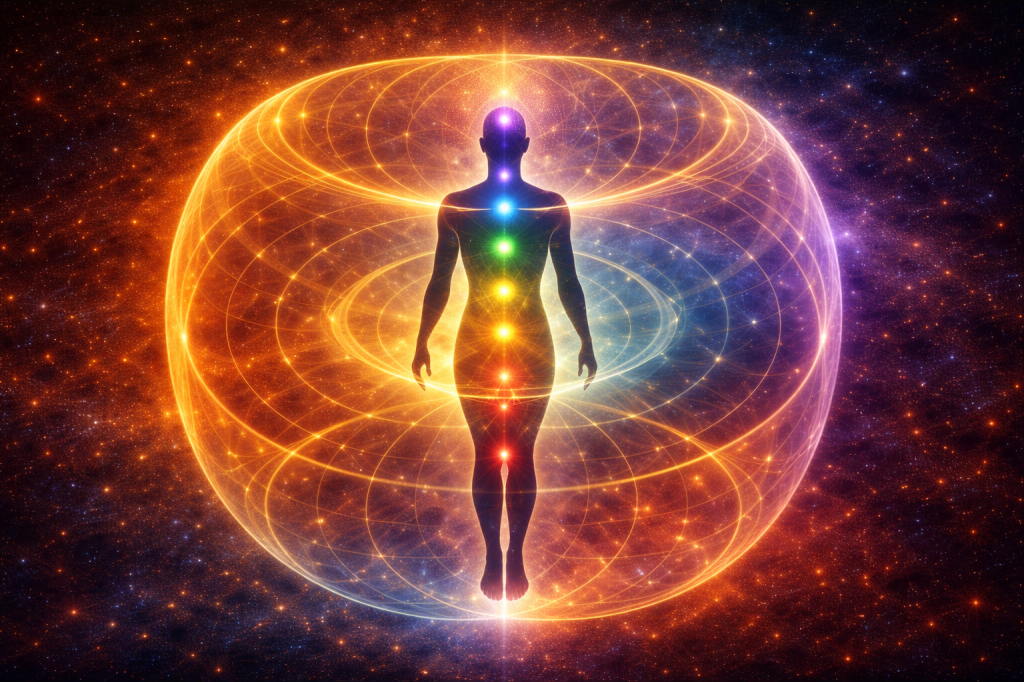
Metaphysical anatomy provides a framework for tracing these interactions. The body is threaded with channels of energy, known as meridians in Chinese medicine or Nadis in yogic systems, which convey vitality and information across organ systems, tissues, and cells. These pathways respond to the quality of thought, emotion, and attention, amplifying some signals while dampening others. Overlaying these flows are the seven primary chakras, each representing centers of energetic integration that align emotional, cognitive, and physiological patterns. For example, the solar plexus chakra regulates confidence, digestion, and energetic expression. The heart chakra governs relational patterns and circulatory flow. The throat chakra aligns communication with physiological resonance. Through these axes of coherence, internal states shape rhythm, tone, and orientation within the living system, illustrating how thought and body circulate together.
Human Design, like chakras, meridians, or symbolic systems, can be seen as another reflection of recurring patterns in energy and behavior. Its centers and channels map tendencies and flows, illustrating how cognition, emotion, and vitality circulate through the body. Yet the focus is not on the system itself, but on what these patterns reveal, the repetition, orientation, and circulation that recur across frameworks and scales. Through the KAQM lens, these correspondences become meaningful not as fixed truths, but as mirrors for observation, showing how internal and external patterns echo one another. By noticing these recurrences, we are invited to engage with questions, rather than answers, allowing insight to loop, reshape, and deepen in alignment with living systems.
These frameworks, whether meridians, chakras, or Human Design, are less about prescriptive systems than they are maps of recurring patterns. They reveal how internal organization circulates and resonates, showing where energy moves freely, where it encounters resistance, and how feedback loops naturally emerge. Observing these correspondences allows us to see not only the structure of thought and embodiment but also the dynamic flow that shapes vitality and coherence, highlighting the ways internal patterns repeat, echo, and influence one another across mind, body, and environment. The influence of thought extends beyond structure into flow and resonance. When mental patterns are sustained, they generate consistent energetic rhythms that can support vitality, clarity, and alignment. When disrupted or fixated, they can produce blockages or tension in specific channels, subtly constraining physiological and emotional responses. Meditation, focused intention, or deliberate reflection, for instance, can re-organize these energetic currents, producing observable shifts in heart rate variability, hormone regulation, and overall coherence. In other words, the body not only registers thought patterns, but it also resonates with them, amplifying some while attenuating others. These dynamics mirror systemic feedback loops. Circulating energy fosters coherence, while stagnation signals misalignment, creating an opportunity for recalibration.
Ancient frameworks such as the I Ching, astrology, the doctrine of signatures, and principles of synchronicity illustrate similar dynamics in symbolic form. Hexagrams, symbolic correspondences, and observed coincidences are not deterministic, but are expressions of patterned feedback, reflecting the interplay between internal states and external conditions. Our thoughts, intentionally or unconsciously, interact with these patterns, reinforcing or shifting them. By recognizing these correlations, it becomes evident that cognition, embodiment, and symbolic resonance are all part of the same circulating system of feedback and pattern formation.
Modern science provides complementary perspectives. Psychoneuroimmunology, systems biology, and research on neuroplasticity show that mental states influence stress responses, immune function, cellular metabolism, and energy production. Thought loops alter internal context, which then shapes external outcomes. The cycle continues recursively, demonstrating that perception, cognition, and physiology are interdependent components of a single, dynamic system. Energy is neither abstract nor incidental. It is a medium through which the system organizes itself, responds, and maintains coherence.
Viewed through the KAQM lens, these processes exemplify recursive knowledge in action. Thoughts, intentions, and observations return, reconfigured by feedback from body, environment, and pattern systems, revealing hidden structures and emergent correlations. Consciousness, like a circulating toroidal field, depends on these loops to sustain orientation, coherence, and insight. Understanding thought as a circulating field provides conceptual scaffolding for exploring how energy organizes structurally, from mitochondria to cellular networks, and ultimately into larger systemic patterns. This perspective allows us to see cognition, embodiment, and energy as integrated aspects of a coherent system.
Ashley Benedict, Astrologer (KAQM)
 Fractal Astrology: KAQM Method