A KAQM Foundation
If thought and perception are shaped by internal patterns, then the body must be understood not as a passive container of those patterns, but as an active participant in their formation. At the most fundamental level, life organizes itself through repeated energetic movement. Mitochondria, often described simply as cellular power plants, are better understood as patterned energy systems. Their internal membranes create precise routes for electrons and ions to circulate, reinforcing certain pathways over others. Energy does not move randomly inside the cell; it follows routes that have proven efficient before. Over time, these routes stabilize, forming structures that both guide and preserve function.
This tendency toward organization through repetition is visible throughout nature in the process of crystallization. Crystals form when energy and matter settle into repeating geometries, not because those geometries are imposed, but because conditions allow patterns to reinforce themselves. Once a lattice emerges, it guides subsequent organization, shaping how energy flows through it. What appears static is actually the residue of movement, a record of energy learning where to go. This same logic applies to biological systems, where structure is less a fixed design and more a memory of repeated flow.
What connects mitochondria, crystallization, and larger biological systems is pattern recognition expressed through structure. Repetition creates preference, preference becomes pathway, and pathway becomes form. The body remembers by routing energy the same way again. Thought becomes habit, habit becomes physiology, and physiology reinforces perception. Through the KAQM lens, pattern recognition is not confined to cognition; it is the mechanism by which systems at every scale stabilize into functional alignment.
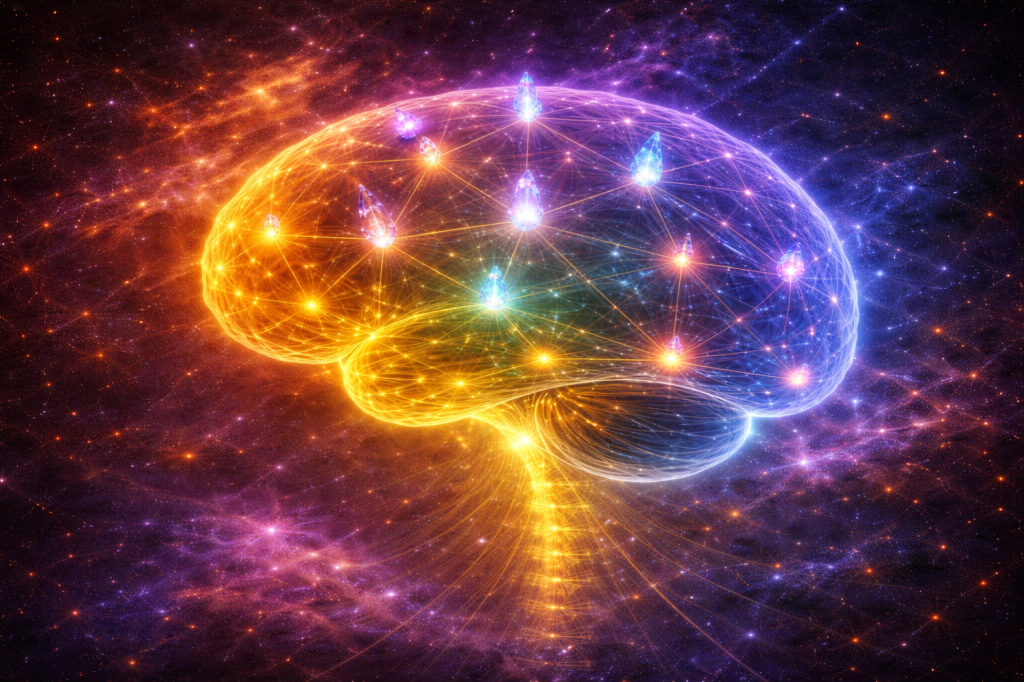
Nowhere is this more evident than in the human brain. Neural networks do not merely transmit information but refine it through repeated use. Myelination, the formation of white matter around neural pathways, acts as a powerful insulator, increasing signal speed and fidelity. Neuroscience imaging shows that in individuals with highly superior autobiographical memory, known as HSAM, there is increased white matter organization around regions associated with memory integration, particularly near the hippocampus. These differences suggest that extraordinary recall is not the result of more information being stored, but of how efficiently patterns are reinforced and routed.
Similarly, post-mortem studies of Albert Einstein’s brain revealed unusually dense white matter around the angular gyrus, a region involved in spatial reasoning, abstraction, and integrative thinking. Neuroscientist Dr. Diane Hennecy has explained that this increased insulation likely supported stronger synchrony across networks responsible for mathematical and conceptual reasoning. These are not anomalies in isolation, but examples of a broader principle: when certain patterns are repeatedly engaged, the brain reorganizes itself structurally to support them.
Even beyond neurons, supporting cells such as astrocytes play a critical role in this process. Once considered passive scaffolding, astrocytes regulate the energetic environment of the brain, managing nutrients, ions, and signaling conditions that allow neural networks to function optimally. Their role further reinforces the idea that intelligence and organization are distributed processes, emerging from coordination rather than centralized control.
Taken together, these examples point to a recurring truth. Energy does not simply move through systems, it learns them. Structure emerges where movement repeats, and intelligence expresses itself through stabilized circulation. This is as true for cellular respiration as it is for memory, perception, and meaning-making. The same recursive logic that organizes mitochondria also organizes thought.
Viewed through the KAQM framework, these phenomena are not isolated discoveries across biology and neuroscience, but expressions of the same underlying pattern. Knowledge forms recursively, reinforcing itself through repeated engagement, shaping the conditions that allow future recognition to occur. What appears as complexity is often the accumulation of aligned pathways, each loop refining the next. This is not merely how the body functions, but how understanding itself takes form.
Ashley Benedict, Astrologer (KAQM)
 Fractal Astrology: KAQM Method