A KAQM Reflection (and Foundation)
A KAQM Inquiry into Psychological Pattern and Physiological Form
There is a quiet assumption embedded in modern language that perception happens in the mind and the body simply follows. We speak of thoughts, stress, anxiety, or calm as though they are mental events that later influence physiology. But the body does not wait for conscious interpretation to act. It is already interpreting. Already organizing. Already adjusting.
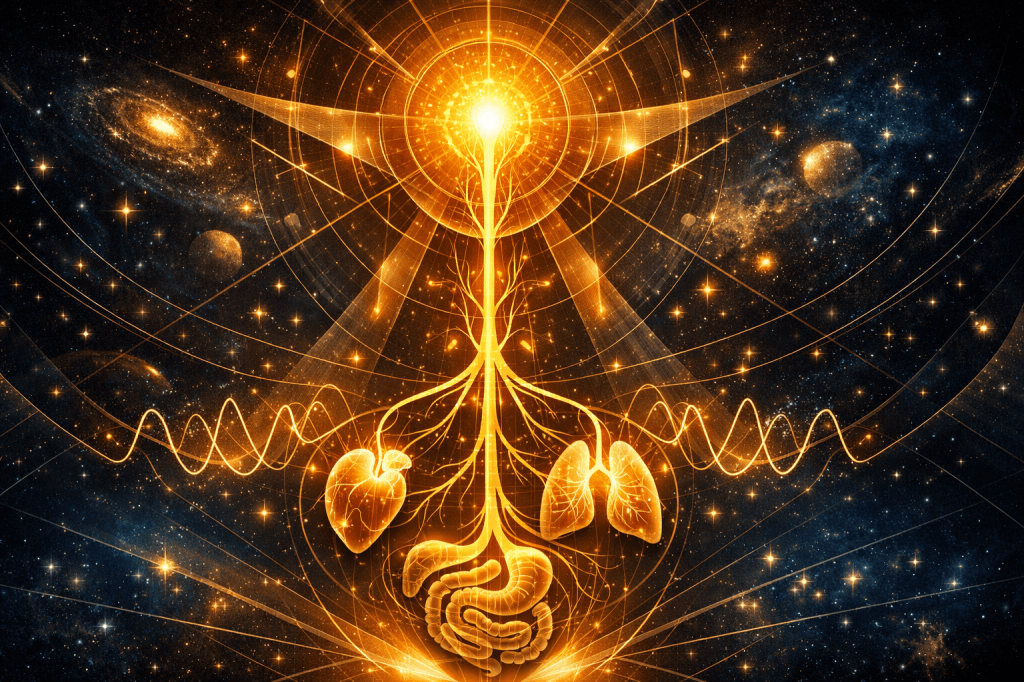
The corridor through which this translation unfolds is the vagus nerve.
Anatomically, the vagus nerve originates in the brainstem and descends through the throat, branching into the heart, lungs, and digestive organs. It is the primary regulator of the parasympathetic nervous system, the branch responsible for rest, digestion, immune modulation, and social engagement. That much belongs to physiology textbooks. But its implications reach further.
The vagus nerve is not simply a regulatory cable. It is a bidirectional interpretive pathway. It carries signals from brain to body and from body to brain. It monitors heart rhythm, breath cadence, gut motility, inflammatory tone. It is constantly evaluating internal and external conditions, asking in its own nonverbal language whether the environment is safe enough for restoration or dangerous enough to require mobilization.
This evaluation is not philosophical. It is biological.
Before the mind narrates experience, the nervous system assigns significance. Tone of voice, facial expression, unpredictability, remembered threat, subtle shifts in posture or breath are scanned and categorized at speeds far faster than conscious thought. What results is a shift in vagal tone, and that shift reorganizes the entire body.
When safety is perceived, the heart slows. Breath deepens. Digestion activates. Inflammation quiets. Muscles soften. Facial expression becomes responsive and socially attuned. The organism moves toward connection.
When threat is perceived, heart rate increases. Breathing becomes shallow. Blood flow redistributes. Digestion pauses. Muscles tighten in preparation for action. The organism shifts toward defense.
Nothing visible may have changed in the external world. Yet the internal geometry reorganizes.
The body does not respond to events. It responds to interpreted meaning.
In KAQM terms, this interpretation does not occur in isolation. It occurs within a fractal field. A self-organizing matrix of perception, memory, and expectation that scales from momentary sensation to long-term identity. Meaning is not a passing thought layered onto biology. It is formative. The organism configures itself in relation to what it has learned significance to be.
This is where the work of Stephen Porges becomes relevant. Through Polyvagal Theory, Porges articulated that the vagus nerve is not a single undifferentiated pathway but part of a layered autonomic architecture. One branch supports social engagement and regulation. Another supports shutdown and immobilization. Between these sits the sympathetic system of mobilization. These are not just emotional moods. but regulatory states. Each state configures the organism differently.
But beyond regulation lies implication.
If the organism continually configures itself around perceived safety or threat, then identity itself is partially scaffolded by autonomic patterning. A chronically defensive system constructs a different worldview than a regulated one. A collapsed system narrates reality differently than an engaged one. Physiology does not merely reflect belief, it stabilizes it.
In KAQM language, the vagus nerve functions as a fractal interface within the larger fractal field of consciousness. A small interpretive adjustment at one scale reorganizes the whole. Perception alters physiology. Physiology reinforces perception. The loop consolidates and the field stabilizes.
Over time, this stabilization becomes character. What began as state consolidates into pattern, and pattern consolidates into what we experience as identity. The fractal field stabilizes around recurring interpretations until they feel structural, even inevitable. Temperament, guardedness, openness, resilience are not purely psychological traits but embodied regulatory histories.
The living question is therefore not simply “What am I thinking?” It is “What meaning has my system learned to expect?”
This is why regulation cannot be reduced to technique. Breathwork, cold exposure, humming, meditation, these can influence vagal tone. They are real tools, but tools operate downstream. The deeper architecture lies in the meaning repeatedly assigned to experience. The nervous system organizes around that meaning long before conscious narrative justifies it.
This reframes healing.
If the body is structured by interpretation, then transformation is not the suppression of response but the reorganization of significance. When perceived meaning shifts, autonomic architecture shifts. When architecture shifts, identity reorganizes. The fractal field does not dissolve; it recalibrates.
KAQM speaks of living questions, of recursive structures, of pattern recognition that precedes conscious reasoning. The vagus nerve is a biological demonstration of that principle. The organism itself is asking: Am I safe? Am I threatened? Am I connected? The answer to that question becomes measurable in heart rate variability, breath rhythm, inflammatory tone, muscular posture.
Meaning becomes biology.
Astrology, when approached through an evolutionary or psychological lens, does not claim to cause these shifts. Rather, it can serve as a timing language for when certain living questions surface more intensely. But whether symbolic or empirical, the body remains the site of translation. The vagus nerve remains the corridor.
What this ultimately reveals is not simply that consciousness affects physiology. It reveals that the organism is interpretive at its core. Biology is responsive architecture shaped by perceived significance.
When interpretation changes, state changes.
When state changes, perception reorganizes.
When perception reorganizes, the field updates.
The vagus nerve makes this visible.
And once it is visible, the division between psychology and physiology becomes difficult to maintain.
They are not two systems.
They are one recursive structure expressing itself at different scales.
Ashley Benedict, Astrologer (KAQM)
 Fractal Astrology: KAQM Method