A KAQM Foundation
Knowing is often treated as something that accumulates. We imagine information stacking upward, producing clarity through volume, refinement, and time. Yet this model fails to explain why systems saturated with data still lose awareness, or why certainty so often precedes collapse. What determines whether a system remains perceptive is not how much it knows, but how it moves what it knows back through itself.
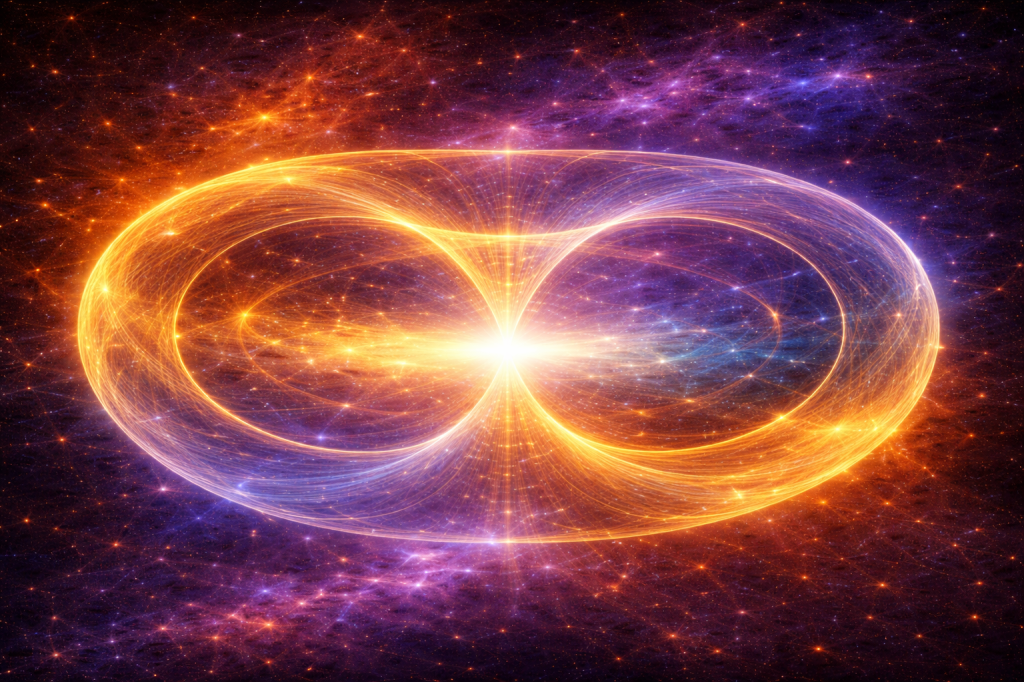
Living systems survive through circulation. Energy, information, and attention move outward, encounter resistance or context, and return altered. This return is not incidental; it is the condition that allows learning. Without it, systems continue operating while gradually detaching from reality. The torus offers a useful geometry for understanding this process. It describes a system that remains open to its environment while preserving internal continuity, allowing output to become input without collapsing into chaos or freezing into rigidity.
In a toroidal system, perception depends on feedback. Information does not travel in a straight line toward conclusion; it loops. Each pass refines orientation, revealing deviation, adjustment, and alignment. This is why systems structured for return remain sensitive. They cannot indefinitely ignore the effects of their own actions, because those effects are routed back into the system’s core. Blindness does not arise from ignorance, but from interrupted circulation.
We see this principle operating throughout biology. Blood circulates to remain oxygenated. Neural signals loop to reinforce learning. Sensory systems rely on continuous feedback to maintain balance and orientation. Even vision depends on recursive processing, where incoming signals are compared against internal models and revised in real time. Where return is preserved, awareness remains dynamic. Where return is blocked, distortion accumulates.
Knowing itself follows the same logic. Understanding is not produced by arriving at an answer and holding it fixed. It emerges through repeated engagement, where questions return reshaped by experience. Insight deepens not through certainty, but through sustained responsiveness. When knowledge stops looping, it hardens. It begins defending its conclusions rather than updating them.
Through the KAQM lens, the torus becomes a model for epistemology rather than metaphor. Knowledge remains valid only so long as it can encounter its own consequences. Meaning stays alive when it is allowed to circulate, to be challenged, revised, and reintegrated. A looping system cannot remain unaware indefinitely, because it must eventually meet itself again.
This distinction matters because it reveals why some systems appear functional long after they have lost awareness. Motion can continue without perception. Activity can persist without sensitivity. What disappears first is not operation, but orientation. The torus clarifies why blindness often looks like confidence from the inside.
This post marks a turning point in the sequence. Until now, we have traced how patterns organize energy, body, and meaning. Here, that logic becomes explicit. The shape of knowing is not arbitrary. It is the geometry required for awareness to remain responsive within complexity.
In the next step, this geometry will extend beyond cognition into fields, timing, and sensitivity itself. Because once a system is understood as circulating, the question is no longer whether it perceives, but how it senses change.
Ashley Benedict, Astrologer (KAQM)
 Fractal Astrology: KAQM Method